January 8, 2024
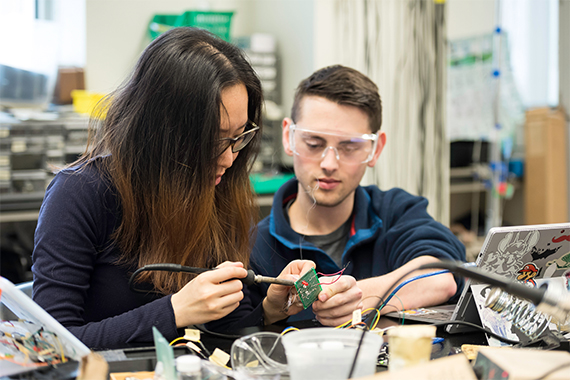
(°µĶų³Ō¹Ļ photography / J. Adam Fenster)
Dear members of the Hajim School community,
Happy New Year! I hope you had a wonderful, recharging holiday season. The Hajim School is already off to a busy start in 2024 and I want to begin the year by sharing a video that showcases what makes a Hajim education so distinct. and reflect on how you can empower Hajim students to make the world ever better.
A LINK BETWEEN THE OCEANā€™S WEATHER AND GLOBAL CLIMATE
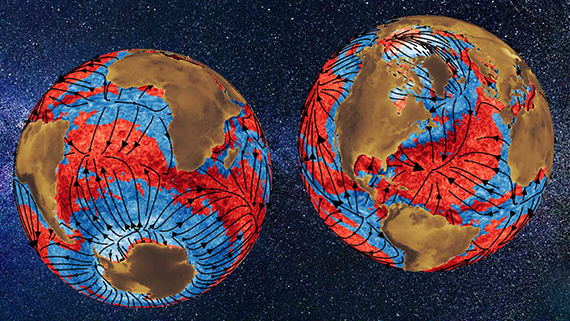
(°µĶų³Ō¹Ļ / Benjamin Storer)
An international team of scientists led byĀ published a study in Science Advances showing the first direct evidence linking seemingly random weather systems in the ocean with climate on a global scale. Hussein, an associate professor in the and staff scientist at theĀ , says the work creates a promising framework for better understanding the climate system.
ā€œScientists have long speculated that these ubiquitous and seemingly random motions in the ocean communicate with climate scales, but it has always been vague because it wasnā€™t clear how to disentangle this complex system to measure their interactions,ā€ says Hussein. ā€œWe developed a framework that can do exactly that. What we found was not what people were expecting because it requires the mediation of the atmosphere.ā€
Read more about this interesting work at the News Center.
MACHINE LEARNING BOOSTS SEARCH FOR NEW MATERIALS
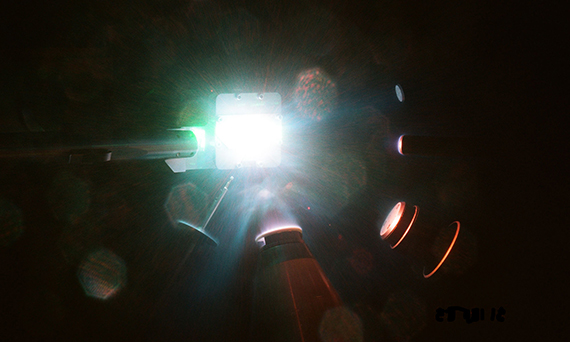
(°µĶų³Ō¹Ļ Laboratory for Laser Energetics photo / Danae Polsin and Gregory Ameele)
Hajim School scientists are using deep learning to supercharge a technique that is already the gold standard for characterizing new materials. An interdisciplinary team led by Associate Professor from theĀ Department of Mechanical EngineeringĀ andĀ Associate ProfessorĀ Ā from theĀ developed models to better leverage the massive amounts of data that X-ray diffraction experiments produce.
During X-ray diffraction experiments, bright lasers shine on a sample, producing diffracted images that contain important information about the materialā€™s structure and properties. Niaz Abdolrahim says conventional methods of analyzing these images can be contentious, time-consuming, and often ineffective.
ā€œThere is a lot of materials science and physics hidden in each one of these images and terabytes of data are being produced every day at facilities and labs worldwide,ā€ says Abdolrahim. ā€œDeveloping a good model to analyze this data can really help expedite materials innovation, understand materials at extreme conditions, and develop materials for different technological applications.ā€
Learn more about the study, published in npj Computational Materials, at the News Center.
ASARO BIGGAR PROFESSORSHIPS/FELLOWSHIPS IN DATA SCIENCE
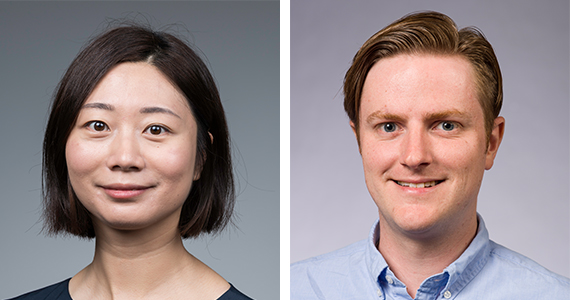
Zhen Bai and Lee Murray (°µĶų³Ō¹Ļ photography / J. Adam Fenster)
Iā€™m delighted to share the newest recipients of the , which support tenured or tenure-track faculty from the Hajim School and the School of Arts & Sciences who use data science methods to frame, analyze, and resolve the most pressing issues in their fields. Assistant Professor Ā from the Department of Computer Science is the Asaro Biggar Family Fellow in Data Science, and Associate Professor Ā from the is the Stephen Biggar ā€™92 and Elisabeth Asaro ā€™92 Fellow in Data Science.
Zhen, an NSF CAREER Award winner, creates embodied and intelligent technologies that augment human learning and communication, particularly for people with diverse abilities (e.g., autism, Deaf and hard-of-hearing) and backgrounds (e.g., underrepresented students in STEM). Leeā€™s research examines the coupling of reactive chemistry in Earthā€™s atmosphere with the climate system, aiming to understand the natural and human factors that control variability in atmospheric composition across the past, present, and future, and how this chemistry then feeds back onto the climate system.
The Asaro Biggar Professorships/Fellowships in Data Science are a gift from Trustee Stephen Biggar ā€™92 and his wife, Elisabeth Asaro-Biggar ā€™92, to support data science at the University. The Biggarsā€™ gift helps the University to recruit and retain the best talent in the rapidly growing and competitive field of data science by funding fellowships for junior faculty and professorships for senior faculty. Fellowships carry a three-year term and allow the University to honor and encourage outstanding faculty early in their careers.
.
SUBMIT AN ENTRY TO THE ART OF SCIENCE COMPETITION
One of my favorite annual traditions, the Art of Science Competition, is now accepting entries for 2024. The goal of the competition is to explore and illuminate the aesthetic beauty that results when science, art, and technology intersect.
The 2024 competition will give consideration to the artistic representation of science, technology, engineering, math, and sustainable themes. Entries with a focus on creativity and uniqueness will be favorably considered. All °µĶų³Ō¹Ļ students, faculty, and staff are invited to enter submissions by 11:59 p.m. on March 17, 2024.
.
NEWLY FUNDED RESEARCH
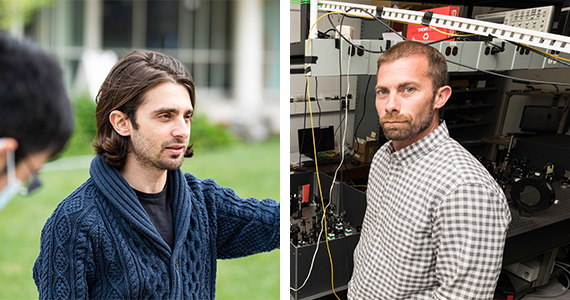
Marc Porosoff and Nick Vamivakas (°µĶų³Ō¹Ļ photography / J. Adam Fenster)
Congratulations to several faculty members who recently secured funding for new sponsored research projects:
- Assistant Professor from the received $299,569 from the National Science Foundationā€™s Division of Chemical, Bioengineering, Environmental, and Transport Systems for a project titled, ā€œ.ā€
- , dean of Graduate Education and Postdoctoral Affairs and the Marie C. Wilson and Joseph C. Wilson Professor of Optical Physics at the , received $50,000 from Physical Sciences Inc. through the US Air Forceā€™s Small Business Innovation Research (SBIR) program for a project titled, ā€œNanostructured low-adhesion surfaces for efficient nanoparticle levitation.ā€
Next week, the University will be closed in celebration of Martin Luther King Jr. Day, so Hajim Highlights will return January 16. I encourage you to take advantage of the events the University has planned to celebrate the holiday, including .
Have a great week!
Your dean,
Wendi Heinzelman

